The short answer: If you want to know how to identify original chikankari, turn the garment (or its product photo) over. Hand-embroidered Chikankari shows small, natural variations in stitch size and tension, and a clean reverse side. In shadow work, the pattern is worked from the back, so it shows through softly on the front. Machine embroidery is perfectly uniform. It often sits stiffly on top of the fabric, and the reverse usually shows messy loops or a backing layer. The seven checks below let you judge most of this from close-up photos before you buy online, and they also show how to check if chikankari is original without handling it in person.
Chikankari is Lucknow’s hand-embroidery tradition, recognised with a Geographical Indication (GI) designation in December 2008. The name sells, so it is widely copied, by machines and sometimes by prints that are embroidery in name only. None of the checks below needs equipment. They need zoom.
Check 1: Look at the reverse side first
This is the most telling test. On the back of real chikankari, the stitches look tidy but slightly uneven, never perfectly uniform. In genuine hand work, especially Bakhiya (shadow work), where the stitching is done on the reverse so the design appears as a soft shadow on the front, the back of the fabric looks neat and deliberate. Machine work usually leaves long floating threads, dense bobbin lines, or a stiff stabiliser backing glued behind the motif. If a listing shows no reverse-side photo at all, ask for one. An honest seller can send it in a minute.
Check 2: Zoom into a repeated motif
Find a motif that repeats: a flower, a leaf, a buti. In hand embroidery, the repeats are siblings, not clones. One petal sits slightly longer, a curve bends a little differently, the stitch density varies. In machine work, every repeat is identical, like wallpaper. Perfection at this level is not a quality signal. It is a production signal.
Check 3: Look for the stitches machines skip
Chikankari is a family of stitches, not one stitch. Learning how to identify hand embroidered chikankari starts with the stitches machines skip. The ones that are hardest to fake convincingly:
- Murri — tiny rice-grain-like raised stitches.
- Phanda — small knot-like dots, like millet grains, used in flowers and vine work.
- Jaali — an open net formed by teasing the fabric’s own threads apart and securing them with minute buttonhole stitches. The result is lace made from the cloth, not applied to it. Machine “jaali” usually looks like cutwork or a uniform mesh.
- Bakhiya — shadow work, described above.
- Taipchi (Tepchi) — a simple long running stitch used to outline motifs. On its own it is the easiest stitch, so a piece that is only taipchi should not be priced like mixed-stitch work.
If a kurti at a very low price claims heavy Jaali and Murri, be sceptical: those stitches are slow, skilled work, and the price has to come from somewhere.
Check 4: Feel (or read) the thread
Hand Chikankari traditionally uses soft cotton or silk thread that sits in the fabric. Machine copies often use shinier synthetic thread that sits on it and can feel stiff or plasticky. When you shop online, judge from the close-up: hand thread looks matte and fibrous, while synthetic thread catches the light with a hard shine. Product descriptions should name the thread and fabric. If they don’t, ask.
Check 5: Check how the pattern meets the garment
Artisans place motifs with the garment’s structure in mind: work flows around a neckline, eases off before a seam, balances across a yoke. Machine patterns are often tiled without that judgement, so motifs get chopped at seams or repeat awkwardly across the placket. Look at the full-garment photo, not just the close-up.
Check 6: Match the price to the claim
Hand embroidery is priced by time and stitch complexity, so genuine hand work costs noticeably more than machine work on similar fabric. A “hand-embroidered, heavy Jaali” kurti priced like a printed one is a contradiction, whichever direction the lie runs. Price alone proves nothing. But if the price contradicts the claim, apply Checks 1–5 more carefully.
Check 7: Read what the seller is willing to put in writing
Sellers of genuine hand work usually specify the stitches used, the fabric, the sizes with measurements, and care instructions, and they show close-ups. Vague listings (“premium Chikankari-style ethnic kurti”) with only distant photos tell you something too. Note the wording, too: “Chikankari-style” is not Chikankari. It is a legally safer way of saying “inspired by.”
The 2-minute online check: judging from photos and descriptions
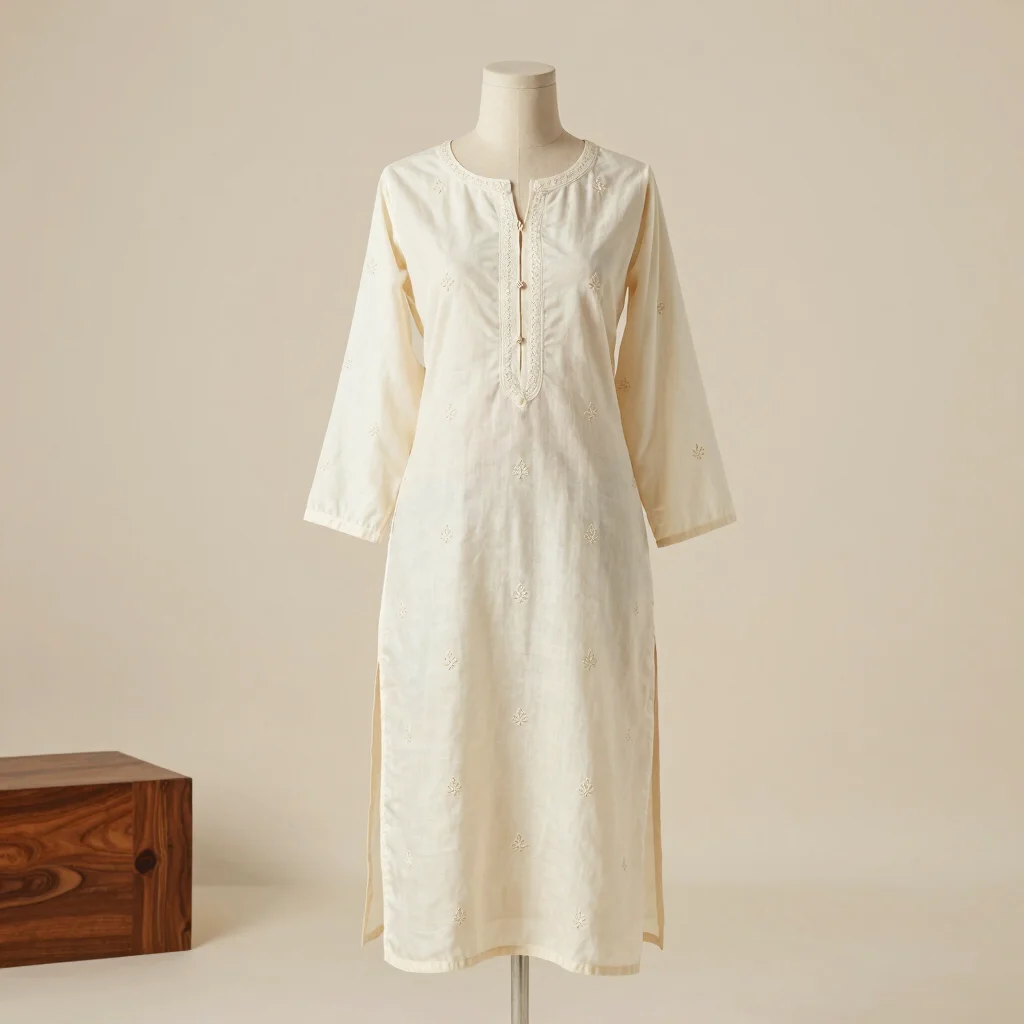
You cannot touch an online listing, so work through its photos and description in the order shown in the table below. The whole pass takes about two minutes per product. What a listing leaves out tells you as much as what it shows: no reverse-side photo, unnamed stitches, or no fabric detail are red flags. In short, treat the photos as a chikankari authenticity check, not just a style preview.
| Step | What to open or read | Pass sign | Red flag |
|---|---|---|---|
| 1 | Closest embroidery close-up | Slight variation between repeated motifs | Every repeat identical |
| 2 | Reverse-side photo | Tidy back; shadow work visible | No reverse photo in the listing |
| 3 | Product description | Stitches, fabric and thread named | Only “Chikankari-style” / “premium ethnic” |
| 4 | Full-garment photo | Motifs flow around neckline and seams | Motifs chopped at seams or placket |
| 5 | Price vs the claim | Price matches the stitch complexity claimed | “Heavy handwork” at a very low price |
Scorecard: hand vs machine at a glance
| Check | Hand-embroidered | Machine-made |
|---|---|---|
| Reverse side | Tidy; shadow work visible | Loose loops, bobbin lines, or stiff backing |
| Repeated motifs | Slight natural variation | Identical repeats |
| Stitch range | Several stitches, incl. Murri/Phanda/Jaali | Few basic patterns |
| Thread look | Matte, integrated with fabric | Shiny, sits on top, stiffer |
| Pattern placement | Flows around neckline/seams | Tiled; motifs cut at seams |
| Price vs claim | Higher, matches stitch complexity | Low price with “heavy handwork” claims |
| Listing detail | Stitches, fabric, sizes, care named | Vague; no close-ups or reverse photo |
When you compare original vs duplicate chikankari, the difference is rarely one detail alone. In chikankari hand vs machine embroidery, hand work shows small variations, a tidy reverse and a wider stitch range, while machine work stays uniform and flat. Use the scorecard as a whole, rather than as a single pass-or-fail test.
What photos cannot prove
Be fair to sellers, and to yourself. Photos cannot prove who embroidered a piece, where, or under what conditions, and they cannot certify GI authenticity. Only documentation and a seller’s track record can answer that. Photos alone cannot prove a piece is genuine chikankari, and they cannot by themselves prove it is fake chikankari either. What photos can do is stop you paying hand-work prices for machine output, which is the most common way buyers lose money in this category.
Hand vs machine: what changes with wear over time
These differences grow with washing and wearing. Hand work uses soft thread worked into the fabric, so with wear the stitches usually relax and settle into the cloth: the surface softens and the embroidery feels more part of the garment than on it.
Machine embroidery is worked in continuous runs under even tension, often over a stabiliser backing. As that backing softens at a different rate from the base fabric, embroidered areas can pucker or stay firmer than the cloth around them. A pulled thread can travel further along a continuous run. One more reason the reverse-side check matters before you buy.
Frequently asked questions
How can I tell if Chikankari is original? Start with the reverse side and repeated motifs (Checks 1–2). Original hand work shows tidy shadow work on the back and slight variation between repeats. Machine work is uniform on the front and messy or backed on the reverse.
What is shadow work in Chikankari? Shadow work (Bakhiya) is embroidered from the reverse side of the fabric, so the design appears on the front as a soft, translucent shadow. It is one of the signature Chikankari techniques, and hard for a machine to copy convincingly.
Why is hand-embroidered Chikankari more expensive? Because stitches like Murri, Phanda and Jaali are slow hand processes, and a single garment can combine several stitches worked by hand. Machine embroidery removes most of that labour, and the price reflects it.
Is machine-made Chikankari “fake”? It is a different product, not automatically a bad one. It becomes a problem only when it is described or priced as hand work. Buy it knowingly, at a machine-work price, if you like it.
Does machine-made Chikankari last? Generally, yes. The stitching itself holds up, and wear life depends more on the base fabric and washing than on the method alone. What changes is the feel: the backing can soften unevenly, leaving embroidered areas puckered or stiffer than the surrounding cloth. Durability is not the issue. Paying hand-work prices for machine output is.
Is a GI tag a guarantee? No. The GI designation given to Lucknow Chikankari in December 2008 certifies the craft’s origin in the Lucknow region and its traditional method. It speaks to where a product comes from, not to the technique of an individual piece. A “GI” claim on a seller’s label is just a claim, not independent verification. Treat it as supporting evidence, and still run Checks 1–7.
What is Jaali work, and how is it different from cutwork? Jaali is an open net formed from the fabric’s own threads, the warp and weft teased apart and secured with minute buttonhole stitches. Cutwork does the opposite: it cuts holes into the fabric and stitches around the edges. Machine “jaali” that looks like a uniform mesh is usually cutwork sold under the Jaali name.
How do I identify original chikankari kurti when buying online? Check the reverse side in photos for slightly uneven hand stitches. Look for stitch types like Bakhiya, Murri and Phanda that machines skip. Match the price to the handwork claim, and treat a very low price for heavy handwork as a warning sign.
The bottom line
You do not need to become an embroidery expert to buy Chikankari well. Zoom in, turn it over, look for the slow stitches, and read the listing like a contract. Those habits are how you recognise original lucknowi chikankari without relying on a label alone. When you are ready to apply the checks, browse our Chikankari Kurtis with close-up photography in mind. If you want help choosing fabric, size and budget once authenticity is settled, read our Chikankari Kurti Buying Guide next.
Sources: National Crafts Museum & Hastkala Academy — Chikankari GI designation (December 2008) and stitch specimens; The Hindu, “Timeless Chikankari” — stitch definitions (Taipchi, Bakhiya, Phanda, Murri, Jali, Keel Kangan, Hool, Zanzeera, Rahet).
For the stitches behind these checks, see the stitches guide, and for the craft’s background, see what Chikankari is.
Once authenticity is clear, the size guide shows how to measure before you order, so the fit matches the piece you have just checked.
Pingback: Chikankari Kurti Buying Guide: How to Choose by Fabric, Stitch, Size and Price – Adaae Couture