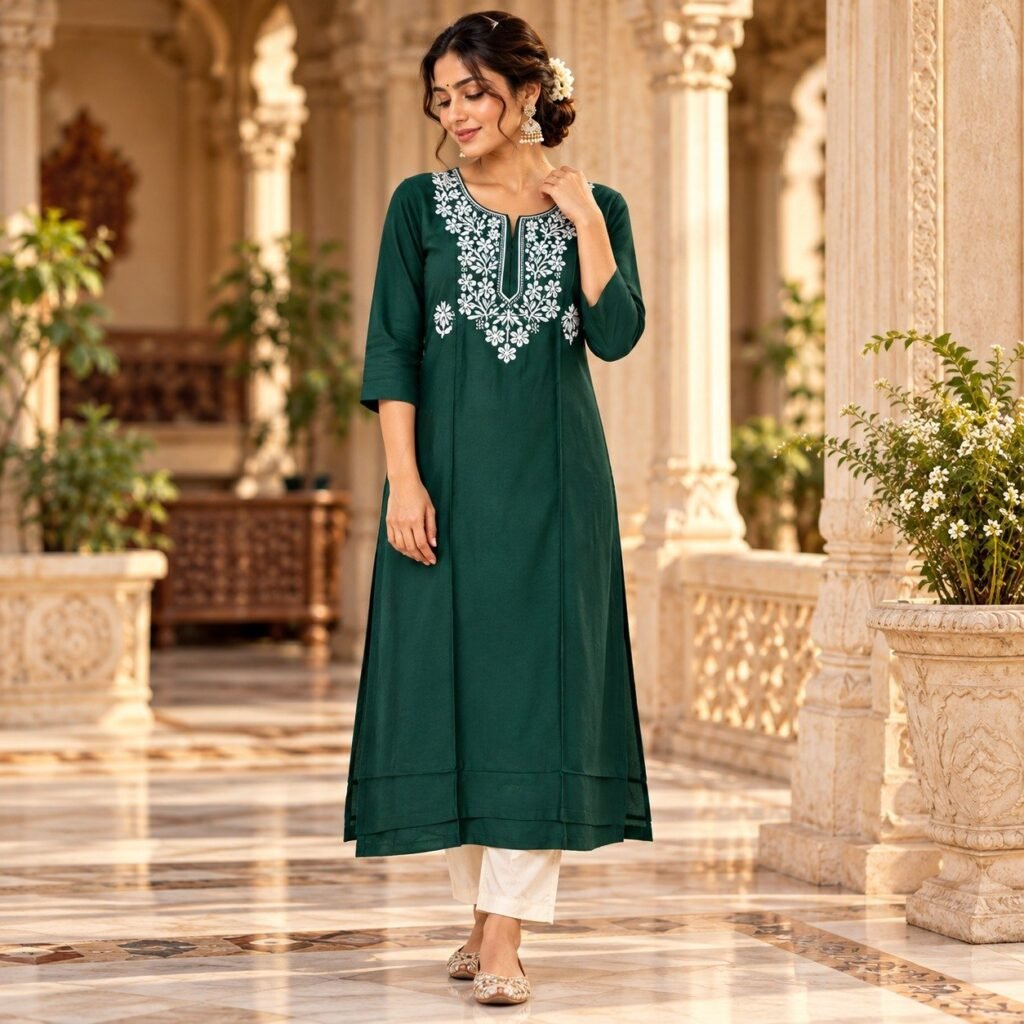
Heritage · Awadh · Lucknow
The Legacy of Lucknow Chikankari
From the courts of Persian-influenced Mughal Hindustan to today’s online wardrobes — how one hand-stitched craft travelled through time.
The Journey
From Then to Now
Where exactly chikankari began is debated, but its path through Lucknow is well loved.
· · · ❖ · · ·
Origins · Uncertain
A name, a legend, a white thread
The word comes from Persian chikan (embroidery) plus kari (work). No firm records fix its arrival, so several stories exist. The best known credits Empress Noor Jahan, wife of Jahangir, with bringing it from Persia. Early pieces were white thread on fine white muslin.
16th–17th Century
Mughal patronage
The craft flourished at the Mughal court, shaped by Persian taste: flowers, creepers and lattice patterns echoing Mughal architecture. Fine muslin suited the hot climate perfectly.
18th–19th Century
The Nawabs of Awadh and Lucknow
As Mughal court life shifted, artisans settled in Awadh and the Nawabs of Lucknow embraced chikankari. The city became its home, and European travellers wrote admiringly of Lucknow’s refinement.
After the Courts
Survival in homes
As royal patronage faded, the craft survived inside Lucknow’s households, carried mainly by women embroiderers, with cutters, printers, tailors and washermen completing each piece.
Late 20th Century – 2008
Chowk, markets and recognition
Lucknow’s Chowk became the main marketplace. In December 2008, chikankari received Geographical Indication status, recognising Lucknow as its exclusive hub and helping protect its identity.
Today
Pastels, co-ords and online stores
Chikankari now appears on georgette, organza, tissue and cotton, in pastels and jewel tones, on kurtis, co-ord sets, sarees, lehengas, bags and home décor — sold through websites, apps and stores across India and abroad.
What Has Changed
Old tradition, updated for modern life
· · · ❖ · · ·
| Then | Now | |
|---|---|---|
| Fabric | Muslin, mulmul | Cotton, voile, georgette, chiffon, organza, tissue, modal |
| Colour | White on white | Pastels, jewel tones and tonal thread, with mukaish, gota or cutdana accents |
| Garments | Court wear: caps, kurtas, angarkhas, scarves | Kurtis, co-ord sets, sarees, lehengas, dupattas, bags, home linen |
| Makers | Court workshops, then household artisans | Artisan families, self-help groups and brand studios |
| Buyers | Royals and nobility | Everyday and festive shoppers, online and abroad |
| Selling | Courts, then Chowk bazaar | Websites, apps, live shopping, boutiques |
| Time per piece | Roughly 5–20 days of hand work by 1–3 artisans | — |
The Chikankari Market Today
Indicative figures from published sources — please check for the latest before quoting.
· · · ❖ · · ·
Trends & Challenges
· · · ❖ · · ·
- Growth drivers: online selling, co-ord and short-kurti styles, pastel palettes, wedding and festive demand, and interest in slow, handmade fashion.
- Machine-made imitation: cheaper computerised embroidery can look similar, but its motifs differ from hand-worked chikan.
- Largely unorganised: the trade relies on middlemen and home-based work, so artisan income and market access are uneven.
- Skills and wellbeing: finding younger skilled embroiderers and protecting artisans’ eyesight are ongoing concerns.
- Positive shifts: GI protection, artisan self-help groups, skilling programmes and direct-to-customer brands are improving visibility and fair pay.
Stitch Glossary
Signature Stitches
· · · ❖ · · ·
Murri
Tiny rice-grain knots; one of the oldest and most sought-after stitches.
Bakhiya
Shadow work stitched on the reverse so it glows through the fabric.
Jaali
Net-like openwork made by gently pulling the threads apart.
Phanda
Small millet-shaped knots that add texture to flower centres.
Tepchi
Simple running stitches used for outlines and fine detail.
SHOP THE COLLECTIONREAD OUR BLOG
Questions about the legacy
How old is Lucknow Chikankari?
Chikankari is a centuries-old embroidery tradition of Lucknow. Tradition links its refinement to the Mughal era and to Nur Jahan, and it flourished under the Nawabs of Awadh. Its Geographical Indication (GI) tag was granted in December 2008.
What are the main Chikankari stitches?
The best-known stitches are Bakhiya (shadow work, stitched from the reverse), Murri (tiny rice-grain knots), Phanda (small millet-like dots) and Jaali (an open, net-like lattice worked without cutting the cloth).
Why does the GI tag matter for Chikankari?
The GI tag, granted to Lucknow Chikankari in December 2008, legally recognises the craft’s link to Lucknow and helps protect buyers and karigars against copies sold under the same name.
How is modern Chikankari different from the old craft?
The stitches and the four-step making process are unchanged. What is new is the styling: modern colours such as emerald green, everyday silhouettes, and complete-look dressing with jewellery and potli bags.
For a plain-language explainer of the craft, read What Is Chikankari?