The short answer: Four decisions, in this order. Pick the fabric for the season and the occasion (cotton covers everyday wear and warm-weather festive days). Then embroidery placement, which sets how formal the kurti looks: neckline-and-cuffs for work, denser work for celebrations. Fit comes from measuring a kurti you already own, not from a size letter. Judge price by the embroidery itself. Sparse outline work and dense mixed-stitch work are different products at different prices, and either can be the right buy.
The examples in this guide are real pieces we currently list, prices included, so you can see how each decision plays out. It also flags where a Chikankari kurti is not the right choice.
Step 1: Choose the fabric for how you’ll actually wear it
Cotton carries most Chikankari, and it is the fabric of every clothing piece we currently list. It breathes, holds its shape well enough to show embroidery clearly, and stays comfortable through long days. Pick it for office wear, everyday wear, daytime pujas, family gatherings and warm-weather festivals.
The wider market also offers georgette and chiffon, which drape softer and look dressier in the evening, and mulmul, the lightest option for peak summer. All are good fabrics. They are simply not what the examples in this guide are made of, and any seller should name the fabric plainly. If a listing only says “premium fabric,” ask which one it is.
Cotton quality checks you can do from a product page
You can’t feel fabric through a screen, but a good product page still gives you four honest clues:
- Weave closeness. Zoom in. Even, closely set threads hold embroidery flat; a loose, open weave snags easily and puckers around dense stitchwork.
- Opacity. Look for a photo taken against light, or a statement of whether it needs a slip or lining. Sheer cotton is not poor cotton, but you should know before it arrives.
- Stitch clarity. Close-ups should show individual stitches with visible texture; distant or soft-focus photos are missing information, not quality.
- Finishing. Check hems, neckline edges and sleeve ends: clean, even finishing is the visible half of construction quality.
One limit to keep in mind: photos cannot prove softness or colour accuracy. Use these checks to build a shortlist and to know what to ask the seller.
Step 2: Read the embroidery — placement first, density second
- Neckline and cuffs only — the most versatile pattern. It reads polished at work and needs no occasion. Example: our Rosewood Chikankari Kurti (₹3,290) concentrates rosewood-toned work at the neckline and cuffs of an ivory cotton kurti.
- Small all-over motifs (buti) — light, even coverage that suits daily wear and layers under jackets. Example: the Ivory Buti Everyday Kurti (₹2,490), with evenly spaced butis across a relaxed ivory cotton silhouette.
- Vine/panel work down the front — more presence, more festive, still wearable in the day. Example: the Blush Vine Festive Kurta (₹4,190) in dusty rose with ivory vines along the placket and hem.
- A coordinated suit set — when the occasion wants a finished look without you assembling one (see Step 5).
Before you pay for “heavy work,” check how the embroidery was made. Our guide to telling hand embroidery from machine work walks through the seven checks, including the reverse-side test.
Step 3: Get the size right by measuring, not guessing
Kurti sizing varies between sellers more than almost any other garment, and embroidered cotton has no stretch to forgive a wrong guess. Measure instead. Lay flat a kurti that fits you well and measure the chest (underarm to underarm × 2), shoulder and length. Compare those three numbers with the seller’s size chart for the exact product. If the chart is not on the product page, ask for it before ordering, not after. Between sizes in a straight-cut kurti, the larger size is usually the safer wear: Chikankari is traditionally worn with ease, not fitted tight. ForFor detailed bust, waist, hip and length guidance, see our Chikankari kurti size guide.
Step 4: Understand the price bands
Here is the range on our own shelf today. Use it to calibrate the wider market, not as a market average:
| Band | What it buys (Adaae examples) | Best for |
|---|---|---|
| Under ₹2,500 | Single everyday kurti, light buti work — Ivory Buti, ₹2,490 | Daily wear, first Chikankari piece |
| ₹2,500–₹4,500 | Finer placement work, festive-leaning kurtas — Rosewood ₹3,290; Blush Vine ₹4,190 | Work-to-celebration, gifting |
| ₹6,000–₹7,000 | A complete 3-piece suit set — Pearl Garden, ₹6,890 | Festive days, weddings-as-guest, one-buy outfits |
Across the wider market you will see Chikankari-labelled kurtis far cheaper than this on marketplaces, and far pricier ones from luxury labels. Cheap usually means machine embroidery, a print, or very sparse work. Any of those can still be fine for a casual kurti, as long as it is sold as what it is. A high price should be justified by stitch complexity and fabric, in writing, on the product page.
Step 5: Kurti alone, or a suit set?
Buy the kurti alone if you already own bottoms and dupattas it will work with. Most buyers get more wears per rupee this way. Buy the suit set if you want one decision to produce a complete outfit: the Pearl Garden Suit Set (₹6,890) pairs its ivory Chikankari kurta with matching straight trousers and a lightweight dupatta, so you do not have to worry about mismatched whites, a real risk when pieces come from different places.
Choosing by occasion
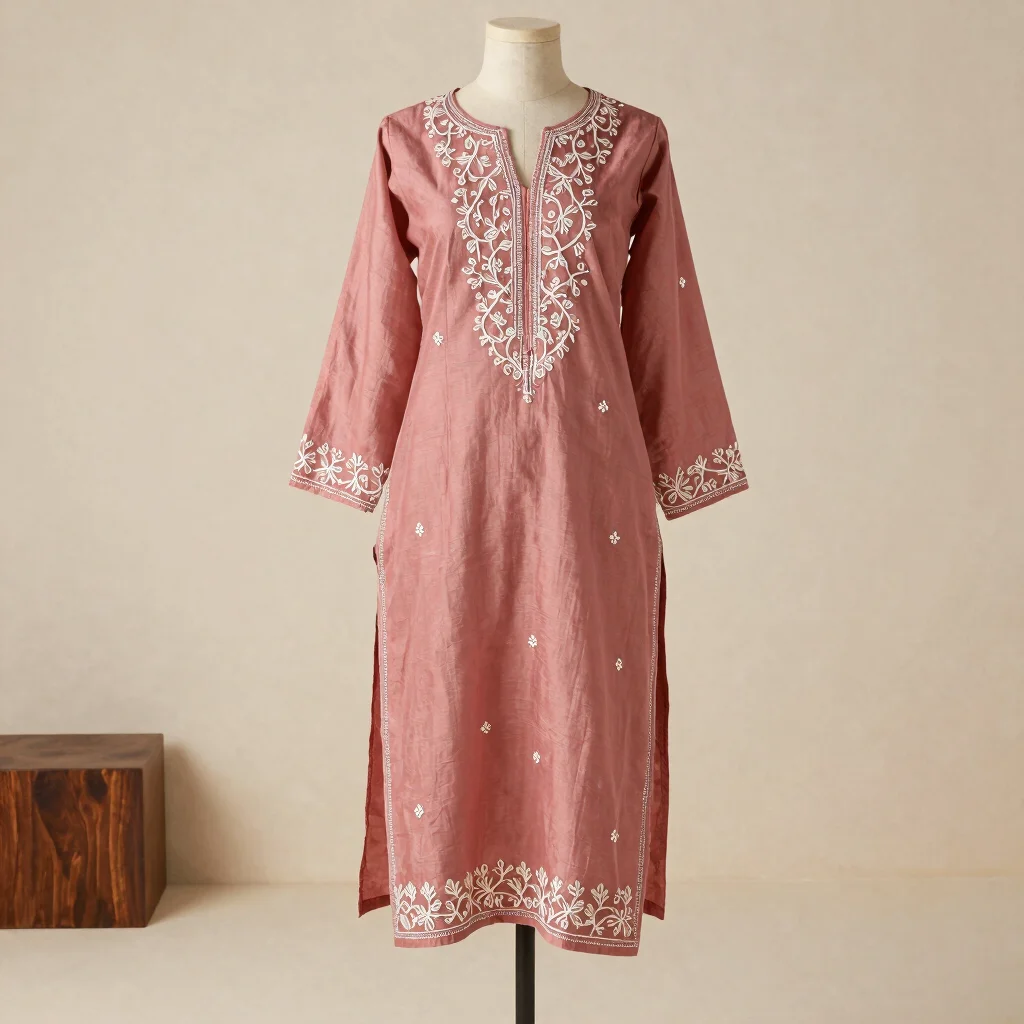
Start from the occasion and work backwards. The event usually decides the fabric, the density and the format:
| Occasion | Fabric & weight | Embroidery | Colour family | Kurti or suit set? |
|---|---|---|---|---|
| Office | Breathable cotton | Neckline-and-cuffs only | Ivory, muted tones | Kurti alone — Rosewood, ₹3,290 |
| Daily wear | Light cotton | Sparse all-over buti | Easy everyday shades | Kurti alone — Ivory Buti, ₹2,490 |
| Family festive | Mid-weight cotton | Vine or panel work, denser | Dusty rose, deeper tones | Festive kurta — Blush Vine, ₹4,190 |
| Wedding guest / celebration | Cotton with the fullest finish | Densest work in the range | Ivory dressed with accessories | Suit set — Pearl Garden, ₹6,890 |
As the occasion gets more formal, what changes is the density and the coordination. The fabric stays the same; one cotton base carries all four rows.
Step 6: Complete the look in the same decision (our difference)
Most Chikankari sellers stop at the garment. Embroidery is decorative on its own, so the jewellery that works with it is specific: small traditional pieces that echo the motif rather than compete with it. That is why we stock the pairings alongside the clothing — Rosewood Jhumka Earrings (₹1,590) against a neckline-embroidered kurti, or a Chikankari Potli Bag (₹2,790) with a festive set. For a gift, a kurti plus one accessory makes a more complete present than a costlier kurti on its own. Our complete Chikankari look guide works through these pairings look by look.
Common buying mistakes
- Judging by the front photo only — always look for a reverse-side or close-up view before paying hand-work prices.
- Buying your “usual size” without measuring — see Step 3.
- Paying festive prices for everyday work — sparse taipchi outline work priced like dense mixed-stitch work.
- Ignoring care — embroidered cotton wants gentle hand washing, shade drying and reverse-side ironing; our guide to washing and storing Chikankari sets out the full routine. If that routine does not fit your life, a simpler, sturdier kurti is the honest choice.
- Forgetting the occasion test — on cost per wear, a kurti you will wear twenty times beats a showpiece you will wear twice.
Frequently asked questions
Which fabric is best for a Chikankari kurti? Cotton, for most buyers: it is breathable, holds embroidery well, and works from office to daytime festivals. Choose georgette or chiffon only when you specifically want a softer, dressier drape for evenings.
How much should a Chikankari kurti cost? It depends on how the embroidery is made and how much of it there is. As a calibration, our everyday cotton kurti is ₹2,490, our festive kurta ₹4,190, and our 3-piece suit set ₹6,890. If a piece claims heavy hand work but is priced far below that seller’s own range, run the seven authenticity checks before buying.
Is a suit set better value than a kurti? Usually yes, if you would otherwise buy trousers and a dupatta separately, and the colours are guaranteed to match. If your wardrobe already covers those pieces, the kurti alone is better value.
Can I wear a Chikankari kurti to the office? Yes. Choose neckline-and-cuff embroidery in a straight cut, pair it with plain trousers, and keep jewellery to one small piece. It is one of the easiest ways to wear handcraft at work without looking festive.
What kurti length suits petite or tall frames? As general styling guidance: knee-length or just below usually balances a petite frame, while tall frames carry longer, calf-length cuts well. Either way, compare the stated length with a kurti you already own (Step 3), not the size letter.
How much should a first Chikankari kurti cost? Start in the everyday band, not the festive one. On our shelf that is the Ivory Buti at ₹2,490, a piece you will wear often enough to learn the care routine on. Move up to the ₹4,190 festive kurta or the ₹6,890 suit set once the first piece has earned its place.
How do I care for a Chikankari kurti after buying? Hand wash cold with mild detergent, dry in shade, iron on the reverse, store folded in a cotton bag. The full routine is in our Chikankari care guide.
The bottom line
Work through the four decisions in order: fabric for how you will wear it, placement for the occasion, your own measurements for the fit, and the embroidery itself when you judge the price. Start with the Chikankari Kurtis and Ethnic Suits collections, apply the four steps to anything you shortlist, and if a detail you need is missing from a product page, ask us through the contact page before you buy.
Shopping by colour, fabric and inner
Shopping by colour is natural, and the checks in this guide apply whatever shade you choose: a blue chikankari kurti in a muted tone can work for the office in the same way the ivory examples do, while a red chikankari kurti will usually read more festive, so check the embroidery density before assuming it will also work for daily wear. The same applies to a yellow chikankari kurti, which shows embroidery clearly but also shows wear, and to a pink chikankari kurti, which sits closest to the dusty rose of the Blush Vine example in this guide.
On fabric, a georgette chikan kurti is the festive alternative mentioned in Step 1: it drapes softer and looks dressier in the evening, but it is not the cotton of the examples here, so ask the seller to name the fabric plainly. And on opacity, inners for chikankari kurti purchases are worth checking before you order: look for a photo taken against light, or a statement of whether the kurti needs a slip or lining, as the opacity check in this guide sets out.
Pingback: How to Tell Real Hand-Embroidered Chikankari from Machine Work: 7 Checks Before You Buy – Adaae Couture