The short answer: three rules. (1) The embroidery is the decoration; jewellery should echo one colour or motif from it, never introduce a new theme. (2) One statement at a time: if the earrings speak, the neckline stays bare, and vice versa. (3) Match the jewellery to the time of day: pearls and small gold-tone pieces for day, enamel colour and a potli for festive evenings. Follow those and any Chikankari outfit assembles itself.
Most styling advice stops at the kurti, because most sellers only sell the kurti. What you add finishes the outfit, and the wrong additions cheapen good embroidery fastest. The looks in this guide are built from pieces actually sold together.
Start with the neckline
Look at the neckline before you choose any jewellery. An embroidered neckline is already jewellery, and a necklace over it creates two focal points competing in the same few inches. A plain, deeper neckline does the opposite: it leaves an empty frame that a pendant is meant to fill.
| Neckline | Earrings | Necklace / pendant | Why it works |
|---|---|---|---|
| Embroidered round neck | Small jhumkas or studs | Skip it | The stitchwork is the neckpiece; earrings add movement without crowding |
| Plain round neck | Small to medium jhumkas | Optional fine pendant if earrings stay small | Room for one neckline piece, not two |
| V-neck / deep neck | Small studs or compact jhumkas | Pendant inside the V | Follows the neckline instead of crossing it |
| High neck / closed neck | Jhumkas carry the look | No necklace | Detail belongs at the ears |
Rule of thumb: the busier the neckline, the quieter the jewellery at the neck, and the more the earrings can do.
Earrings: echo the thread, size to the neckline
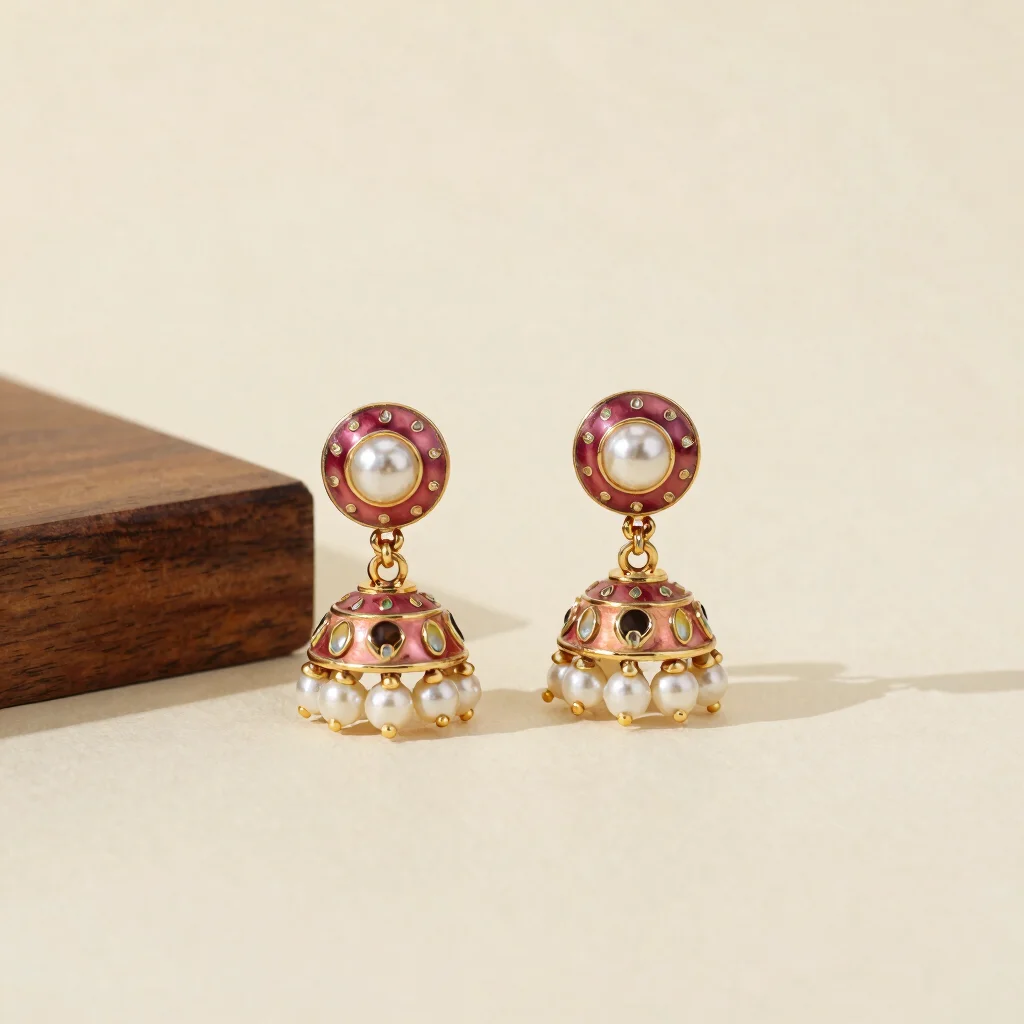
- Embroidered neckline → small, close earrings. The work at the neck is already the focal point. Our Rosewood Jhumka Earrings (₹1,590) work here because they are compact: rosewood enamel that echoes the Rosewood Kurti’s thread tone, with a single pearl drop that picks up the ivory base.
- Plain neckline, all-over buti → earrings can grow slightly, but keep them traditional in shape. Modern geometric earrings clash with Chikankari’s style; jhumkas, studs and small chandbalis match it.
- Skip the necklace when earrings are on. An embroidered neckline plus earrings plus a necklace leaves the eye nowhere to rest.
Bangles and pendants: the supporting cast
- Bangles belong on the wrist opposite your bag hand, in a slim profile that won’t snag embroidery. The Pearl Line Bangles (₹1,890) are a slim gold-tone pair with ivory pearl accents. They layer neatly and suit ivory-based outfits especially, because pearl repeats the white-on-white look of classic Chikankari.
- Pendants are for plainer kurtis and deeper necklines. The open lotus of our Lotus Filigree Pendant (₹2,190) works because a lotus is a motif Chikankari itself uses, so the jewellery reads as part of the same design, and the fine chain doesn’t compete with stitchwork.
Colour pairing rules
Chikankari colour is usually soft: an ivory or pastel base with thread in the same family. Jewellery should stay inside that family, an echo rather than a contrast.
Ivory and white bases, like the Ivory Buti Everyday Kurti (₹2,490) and the Pearl Garden Suit Set (₹6,890), are the most forgiving. Pearl is the natural partner because it repeats the white-on-white softness of the work, which is why the Pearl Line Bangles sit so easily with both. Warm gold-tone adds richness for festive wear; keep it fine, not chunky.
Rosewood and dusty rose, like the Rosewood Chikankari Kurti (₹3,290), want an exact echo. The Rosewood Jhumkas repeat the thread tone in enamel, and their single pearl drop reintroduces the ivory base so the match does not feel flat.
Blush, like the Blush Vine Festive Kurta (₹4,190), sits between the two. Gold-tone and pearl both suit it, and the same rosewood jhumkas work because dusty rose and blush are one colour family. Avoid a third, unrelated colour at the bag or wrist.
The potli: the piece people forget until they need it
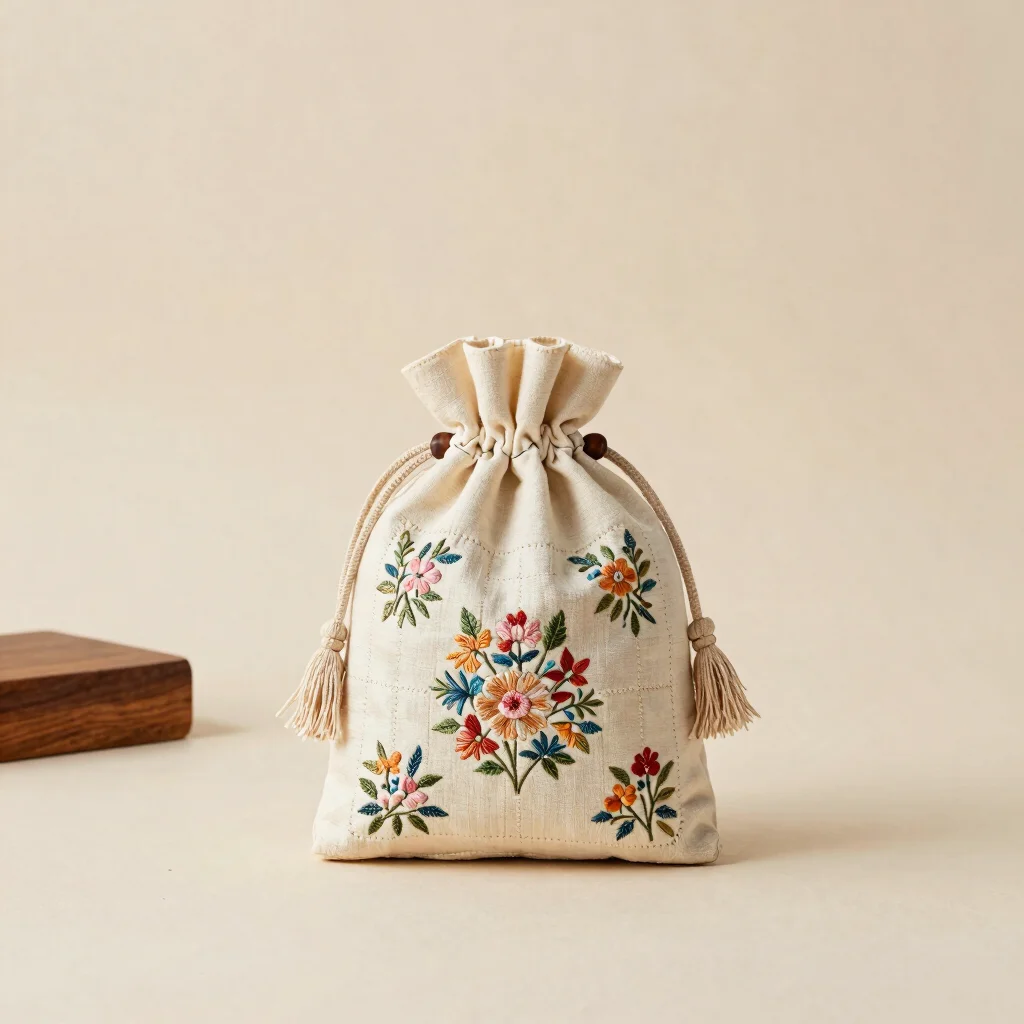
A modern handbag looks out of place with a festive outfit. A potli is scaled to ethnic wear, leaves your hands free, and is itself Chikankari: the Chikankari Potli Bag (₹2,790) carries floral embroidery on ivory cotton with a drawstring and tassels, and holds a phone, keys, cards and lipstick. One rule: the potli’s base colour should match the outfit’s base colour, and its embroidery does the rest.
Three complete looks
| Look | Base | Add | Total of the add-ons | Works for |
|---|---|---|---|---|
| Everyday polished | Ivory Buti Everyday Kurti ₹2,490 | Lotus Pendant ₹2,190 — or nothing; buti work carries the day | ₹2,190 | Office, lunches, daily wear |
| The rosewood set | Rosewood Chikankari Kurti ₹3,290 | Rosewood Jhumkas ₹1,590 + Pearl Line Bangles ₹1,890 | ₹3,480 | Family gatherings, festive days |
| Full festive | Pearl Garden Suit Set ₹6,890 | Pearl Line Bangles ₹1,890 + Chikankari Potli ₹2,790 | ₹4,680 | Daytime celebrations, wedding-guest, Diwali puja |
For a softer version, swap the base to the Blush Vine Festive Kurta (₹4,190) and keep the same jhumkas. Dusty rose and rosewood sit in one family.
Style by occasion
The same pieces can work for three occasions if you change only the additions. You are not buying three outfits; you are adjusting one outfit up or down.
Office and daytime. Ivory Buti Everyday Kurti, with jewellery kept to a single point: the Lotus Filigree Pendant or small earrings, not both. No potli; your regular work bag is correct. Everything else stays quiet.
Family festive. Move to the Rosewood set. The deeper tone looks more dressed than ivory, enamel jhumkas add colour at the face, and the Pearl Line Bangles add the festive note at the wrist.
Wedding guest and Diwali evening. Use the full festive build: Pearl Garden Suit Set, bangles on, the Chikankari Potli instead of a daytime bag, and the dupatta styled deliberately (see below). What changes is completeness: garment, wrist and bag in the same craft. For colour instead of ivory, the Blush Vine Festive Kurta with the same jhumkas and potli gives the softer version.
Complete the look beyond jewellery
Two things finish the outfit after the jewellery, both from your own wardrobe. Adaae does not sell footwear or standalone dupattas.
Footwear. Embroidered juttis or mojaris are the classic pairing; choose a neutral shade or a tone already in the outfit. Kolhapuris and low block-heels in tan or gold-tone work for day. Avoid high stilettos with a festive suit set; they fight its softness.
Dupatta. The Pearl Garden Suit Set includes a dupatta as part of the set. Drape it over one shoulder, falling long, to keep the embroidery visible, or pleat and pin it for a neater look. With a kurti-only outfit, a plain dupatta in the base colour from your wardrobe adds formality. Keep it unembroidered.
Buying the complete look as a gift
A complete look is an easier gift than a single garment because the pairing decisions are already made. Build it around the base piece first, then add the echo.
| Gift basket | Pieces | Total |
|---|---|---|
| Thoughtful starter | Rosewood Chikankari Kurti ₹3,290 + Rosewood Jhumka Earrings ₹1,590 | ₹4,880 |
| Soft festive gift | Blush Vine Festive Kurta ₹4,190 + Rosewood Jhumka Earrings ₹1,590 + Chikankari Potli Bag ₹2,790 | ₹8,570 |
| Complete festive gift | Pearl Garden Suit Set ₹6,890 + Pearl Line Bangles ₹1,890 + Chikankari Potli Bag ₹2,790 | ₹11,570 |
Unsure of taste? The Rosewood basket is the safest, because the colour echo makes it read as a set, not two separate items. For a larger occasion, the suit-set basket is the most complete. Check the product page for size and details before ordering.
Styling mistakes that undo good embroidery
- Chunky modern jewellery over fine stitchwork: the scale mismatch reads as costume.
- Mixing metal tones: gold-tone bangles with silver earrings split the outfit in two.
- A printed sling bag with an embroidered suit: two competing crafts, neither wins.
- Dressing an everyday kurti to festive level: the buti kurti’s charm is restraint, and one pendant is the ceiling.
- Matching everything exactly: echo one element (colour or motif), not all of them, or the look turns uniform.
Frequently asked questions
What jewellery goes best with a Chikankari kurti? Small traditional pieces in one metal tone that echo a colour or motif in the embroidery — jhumkas for embroidered necklines, a fine pendant for plain ones, slim bangles rather than stacked sets.
Can I wear a necklace with Chikankari? Yes, when the neckline is plain and earrings are small or skipped. With an embroidered neckline, let the stitchwork be the necklace.
Is a potli bag practical, or just decorative? Practical for festive needs: it holds a phone, keys, cards and one makeup essential, and it keeps your hands free, which a clutch doesn’t.
How do I turn a daytime Chikankari outfit festive without changing clothes? Add the jhumkas, swap your bag for the potli, and add the bangles. Three additions, no outfit change.
What colour jewellery goes with white or ivory Chikankari? Pearl and warm gold-tone work best. Pearl repeats the white-on-white softness of classic Chikankari, as with the Pearl Line Bangles; fine gold-tone adds warmth for festive wear. Keep the scale small.
Can I mix gold and silver with Chikankari? Better not to. Mixing tones splits the outfit and distracts from the stitchwork. Choose one tone throughout, and let enamel, pearl or thread colour provide the variety.
What bag should I carry with a Chikankari suit set? A potli — it is scaled to ethnic wear, leaves hands free, and introduces no competing print. Match its base colour to the outfit’s, as the Chikankari Potli Bag does with ivory-based sets.
The bottom line
Buy the embroidery first, then echo it: earrings repeating its colour, bangles its softness, a potli its craft. Every piece above is in our Traditional Jewellery and clothing collections, chosen to be worn together. That, in one order, is the complete look. For a ready-made three-piece base, see the suit-set guide, and for choosing the kurti itself, see the buying guide.
Pingback: Chikankari Kurti Buying Guide: How to Choose by Fabric, Stitch, Size and Price – Adaae Couture